Constituency management for Lok Sabha and Vidhan Sabha campaigns

Win the constituency family by family.

ConScan brings election history, ground research and family maps into one system. It works because every party worker gets a way to contribute, and because the leader can finally talk to each of them, and reach each household, personally.

Built on election research that began in 2001. An AI-enabled system, from state down to the individual voter.

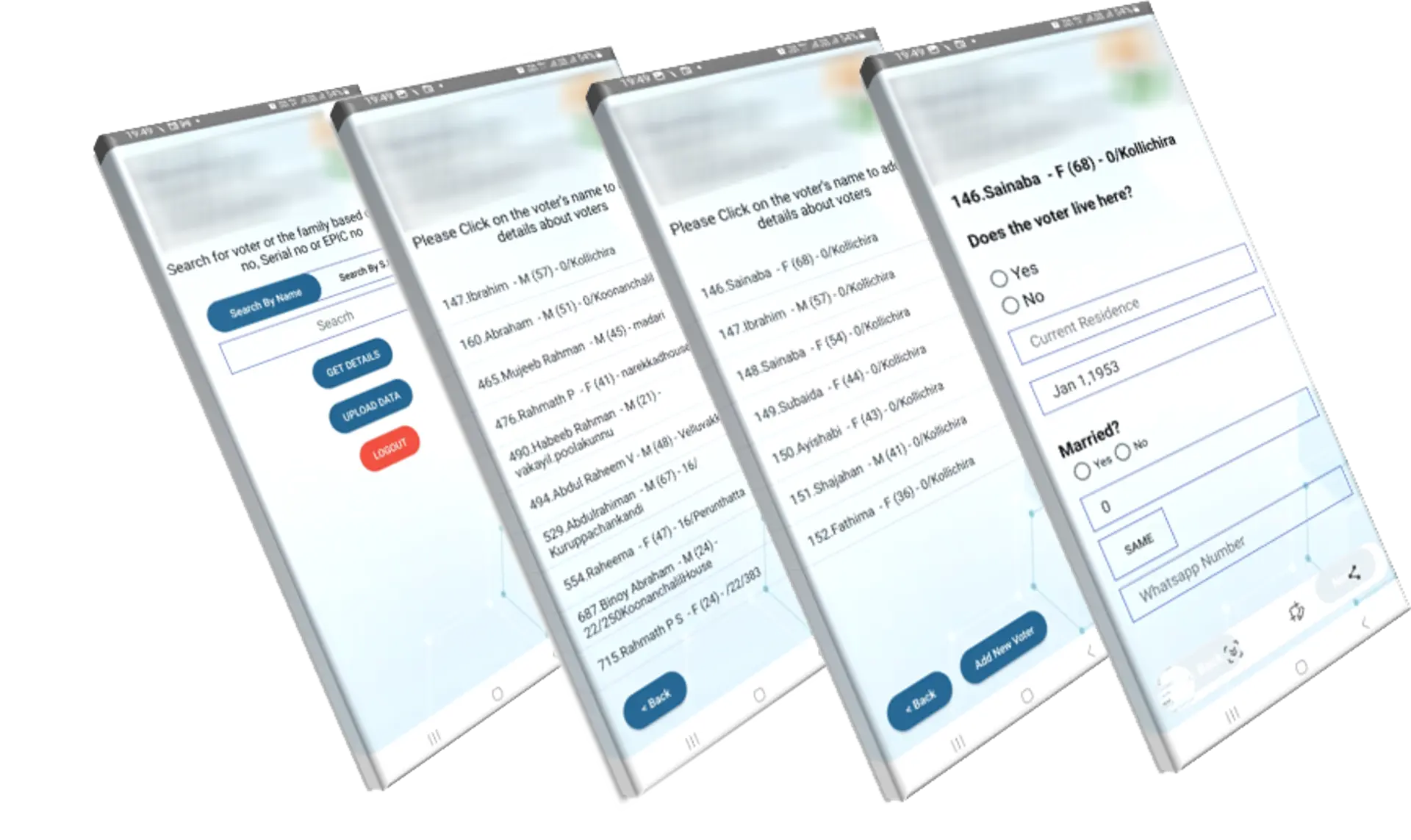
ConScan worker app screens showing voter search, voter lists and a voter survey form

Illustration of the system, not real data.

2001where the research behind the method began
25+ yearsof election research behind every step
State to voterone hierarchy, one view, down to the individual
4 appsConsole, Leader, Booth President and Worker, all connected
What it does for the party

Six things a campaign gets on day one.

Most campaigns run on scattered spreadsheets, a few trusted people and instinct. ConScan replaces the scatter with one picture that every level of the party can act on.

01

Know where the seat is decided

Every booth is sorted by how it voted in the past: won by a wide margin, within reach, or lost by a wide margin. The contested middle stands out at once.

The gain: leadership stops spreading effort thinly and starts working the booths that decide the result.

02

Put effort where votes can move

Each voter carries a vote probability, built from six elections, ground conditions, family details and surveys. It tells the party who needs persuasion and who needs a reason to turn out.

The gain: time and money go to swing families, not to those already decided either way.

03

Be present in every household

Every family is mapped by locality: who lives there, their life stage, what they have raised, and which worker knows them.

The gain: the party is known in the whole constituency, not only in the loudest streets.

04

Turn workers into contributors

From the booth president to the newest volunteer, everyone has a role, a list and a way to feed what they learn back into the system.

The gain: an organisation that listens, and workers who can see that their effort counts.

05

Say the right thing to the right family

Messages follow the outreach band and the family's life. A first vote, a birthday, a birth or a loss each calls for something different.

The gain: persuasion that feels personal, and consolidation that feels like care.

06

See the whole campaign on one screen

The Central Console shows progress booth by booth, worker activity and open follow-ups, from state level down to a single locality.

The gain: decisions made on what is happening on the ground this week, not last quarter.

See it: the booth sorter

The seat is decided in a handful of booths.

Each square is one booth from an imaginary constituency. Green booths were won by a wide margin, amber were within reach, red were lost by a wide margin. Move the slider to see which lost booths come back if the margin improves.

47won today
8lost booths that flip
41still out of reach

Illustrative data for 96 booths. Classes follow ConScan's A, B and C sorting: won by more than 30 points, within 30, lost by more than 30. Booths ringed in dark are the ones that flip.

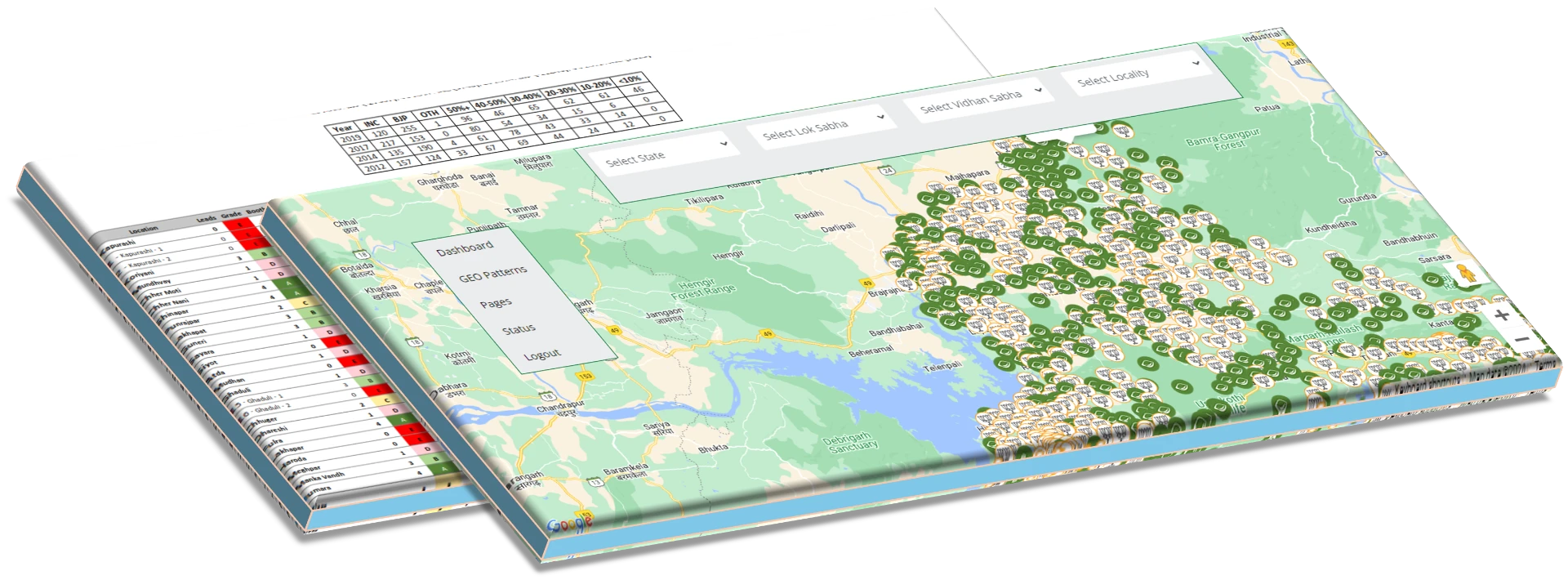
ConScan constituency map with booth markers, state, Lok Sabha, Vidhan Sabha and locality selectors, alongside a locality results table
One system

We bring the data together. Then we weave it.

Election results, ground conditions, family details, surveys and what workers learn each day usually live in different places. ConScan lines them up on the same map and blends them into a single view of each family and voter.

Layer 1 of 6 · Six elections digitised

Election history

Booth-wise results from six elections are digitised, and booths are tied to stable localities so results can be compared over time.

What it adds: Where the party has been strong, weak or swinging, booth by booth and locality by locality.
State→Constituency→Booth→Locality→Family→Voter

Booth numbers change between elections. Localities do not. ConScan anchors every layer to the locality, so six elections of results line up.

Six layers in. One probability, one action out, for every voter.

Every worker contributes

The system works because everyone feeds it.

A database is only as good as the people who keep it alive. ConScan gives each person in the party a role that is clear, a list that is short and a reason to keep contributing: they see what their work has changed.

Sees

  • Booth-wise progress across the whole constituency
  • Belts, bands and open follow-ups
  • Which workers are active and which have gone quiet

Contributes

  • Targets and priorities for each belt
  • Messages and campaign decisions
  • Approval of key changes

Gets back

  • A live picture from the ground, not last month’s report
  • Every decision tied to booths and families

One visit, and what happens next

Kavita visits the Verma family, confirms who lives there and notes that Priya will vote for the first time.

Part of every family

Every household mapped. Every milestone remembered.

Campaigns are remembered for how they treated people between elections. ConScan maps every family in the constituency, so the party can be there when it matters to them: the first vote, the birthday, the new baby, the loss.

The Verma householdNehru Colony · Booth 118 · fictional example
Swing vote · est. 42%
Ramesh, 58Head of household
Sunita, 54Homemaker
Ankit, 27 · Meera, 25Working couple
Priya, 19College student
Kamla, 82Grandmother
Worker: Kavita D.Knows the family
Raised by the family

Street light on lane 3. Scholarship form for Priya.

Milestone
Turns 19Priya is voting for the first time this year.
Suggested next step: Kavita visits, checks Priya’s registration and shares a short, plain note on how to vote. Priya’s questions are logged for the booth.

Outreach band is an estimate used to plan outreach. It is not a verdict on the family and never affects the help they receive.

1

Mapped, not guessed

Households are mapped locality by locality, with members, life stages and what each family has raised. Localities stay constant even when booth numbers change.

2

A name for every family

Each family has a worker who knows them. The party stops being a distant name and becomes a familiar face.

3

Present in life, not only at elections

Personal milestones such as birthdays, anniversaries, births and bereavements are tracked, so the party can stand with a family in good times and bad.

4

Help that is real

Issues a family raises are logged, routed and closed with the family. Help with schemes and grievances is genuine casework, never conditional on political support.

Talk to every worker, individually

Not a broadcast group. A conversation with each one.

Leaders speak to workers in bulk. Most never hear back and quietly drift away. ConScan knows each worker, their booth, their families and their record, so the party can write to every one of them personally, in their language, and hear back.

Five fictional workers. Choose one to see the message the system would prepare for them.

Ramesh Y.
Personal message from the Central Console, not a broadcast
Namaste Ramesh ji. Booth 118: 46 of 60 families are updated, thanks to you. 14 remain, mostly in Nehru Colony. Could you and two workers cover them this weekend?
Yes. Kavita and Arjun will join me on Saturday.
Done. Your list is ready in the app. Thank you.

Without it

One message to a large group. Nobody knows who read it, who is stuck and who has gone quiet. Good workers leave without anyone noticing.

With ConScan

Each worker hears about their own booth, their own families and their own progress, thanked by name, asked for their view, and noticed if they go quiet.
From probability to action

Every family lands in a band. Every band has a job.

The vote probability is blended from six layers. What matters is what the party does with it, so each band comes with an action.

0–30%

Low priority

Unlikely to vote for you. Damage control strategy needed. Are they individuals with preferences, or communities/ social groups voting against you?

30–50%

Swing vote

Focus of the campaign — persuade. These are voters who would decide the outcome of the next election. How well can we reach them.

50–60%

Consolidate

Priority outreach. Bring leaning families firmly across.

60–100%

Locked in

This is your base vote. Every voter who does not turn out to vote is a direct loss. 'Get Out the Vote' systems critical. Candidates and their teams need to show up in person, or they will not show up.

42%

Swing vote. Persuasion. Send the worker who knows them best, listen first, and answer what they have raised.

How to read a score: it is a planning estimate for outreach, not a certified fact about how any person will vote. It is never a reason to withhold service from a family or to treat them differently.
How it comes together

Six steps from past results to the last voter.

1

Analyse the booths

Six elections digitised and every booth sorted into A, B and C by margin, for your party and for each rival.

2

Geo analysis

Vote share in four bands (below 30, 30 to 50, 50 to 65, above 65) shows weak, contest and strong belts. Then simulate what a win by 10 points would take.

3

Map the localities

The ground team records the political landscape, leaders, influencers, organisations and local needs, locality by locality.

4

Map every voter

Families and individuals are added, with life stage and personal milestones, and tied to the worker who knows them.

5

Survey the constituency

An overview survey, ideally every six months and at least once a year, keeps the read of the ground fresh and feeds the probability.

6

Put it in every hand

Central Console, Leader App, Booth President App and Worker App carry the picture to each person, with a WhatsApp network for day-to-day contact.

Trust and responsible use

Detailed data calls for careful handling.

Family-level information is sensitive. ConScan is built for legitimate campaign relationship-building, and it is designed around the following.

How the data is protected

  • Role-based access. Each person sees only what their role needs: their booth, their localities, their families.
  • Campaign data isolation. Each campaign's data is kept separate from every other campaign's.
  • Centralised accounts. The party controls who has access, and can remove it in one place.

How it should be used

  • Contact details come from open and consensual sources: the electoral roll and workers who volunteer their own networks.
  • Family details are for the campaign's own outreach and relationship-building, not for publication or sharing outside the team.
  • Community or financial notes, where recorded, are a local worker's informal view. They are labelled as that, and are not treated as facts.

What it must never be used for

  • Withholding a scheme, service or grievance response from a family because of a score or a suspected preference.
  • Treating a probability as a certainty about how a person will vote.
  • Conditioning any government benefit on political support, or implying a campaign holds powers it does not.

Grievances as a real service

  • A grievance is received, escalated, resolved and closed with the family.
  • The loop is a service to the constituent, whatever the family's politics.
Questions

What campaign teams ask first.

Is ConScan for both Lok Sabha and Vidhan Sabha campaigns?

Yes. The same hierarchy works from a state down to a single constituency, and from a constituency down to the individual voter.

What do we need to begin?

A booth list matched to the electoral roll, and one named contact worker for each booth. The team digitises past results and starts the locality mapping from there.

Our workers are not all comfortable with technology. Will it work for them?

The apps are built by role, so each person sees only what they need. A WhatsApp network gives every worker a familiar way to stay in touch, and the party can write to each one individually.

What happens when booth numbers change?

Booth numbers change between elections, but localities remain constant. ConScan anchors every result to the locality, so six elections of data stay comparable.

Does a high probability mean a family will vote for us?

No. The score is a planning estimate for outreach. It should never be used to disadvantage a voter, and it is refreshed by fresh surveys and worker feedback.

Who can see our data?

People in your party, according to the role you give them. Each campaign's data is isolated from other campaigns, and accounts are managed centrally.

How often is the survey repeated?

Ideally every six months, and at least once a year, so the picture stays current.

Contact us

See your own constituency in ConScan.

Tell us what you are preparing for. We will come back with a walkthrough built around your booths, your belts and your workers.

Tell us a little about you and your seat, and we will take it from there.

Or reach us directly:connect@pollfirst.inWhatsApp